
Before any of us submitted to Jesus as King, we were strangers. Scripture calls this philoxenia, the love of the stranger and it sits at the very centre of God’s heart.
Who is the stranger in Scripture?
Do they need to look like us, think like us, or fit our categories to receive our hospitality?
Not at all.
The “outsider” could be someone homeless or someone wealthy; a neighbour or a newcomer; someone socially invisible or socially celebrated.
In Jesus, every one of us is deeply in need of His grace and salvation.
Hospitality begins with God, not us. While we were still enemies of God, He set the table. He became the meal. He took the first step. The Word became flesh the greatest act of hospitality in history.
His initiative. His invitation. His provision.
Because we are made in His image, we get to extend that same hospitality to whoever is being added to us.
A small, practical encouragement:
Let’s look out for new people. Take the initiative. Greet first. Invite first. Take the first step, just as God did with us.
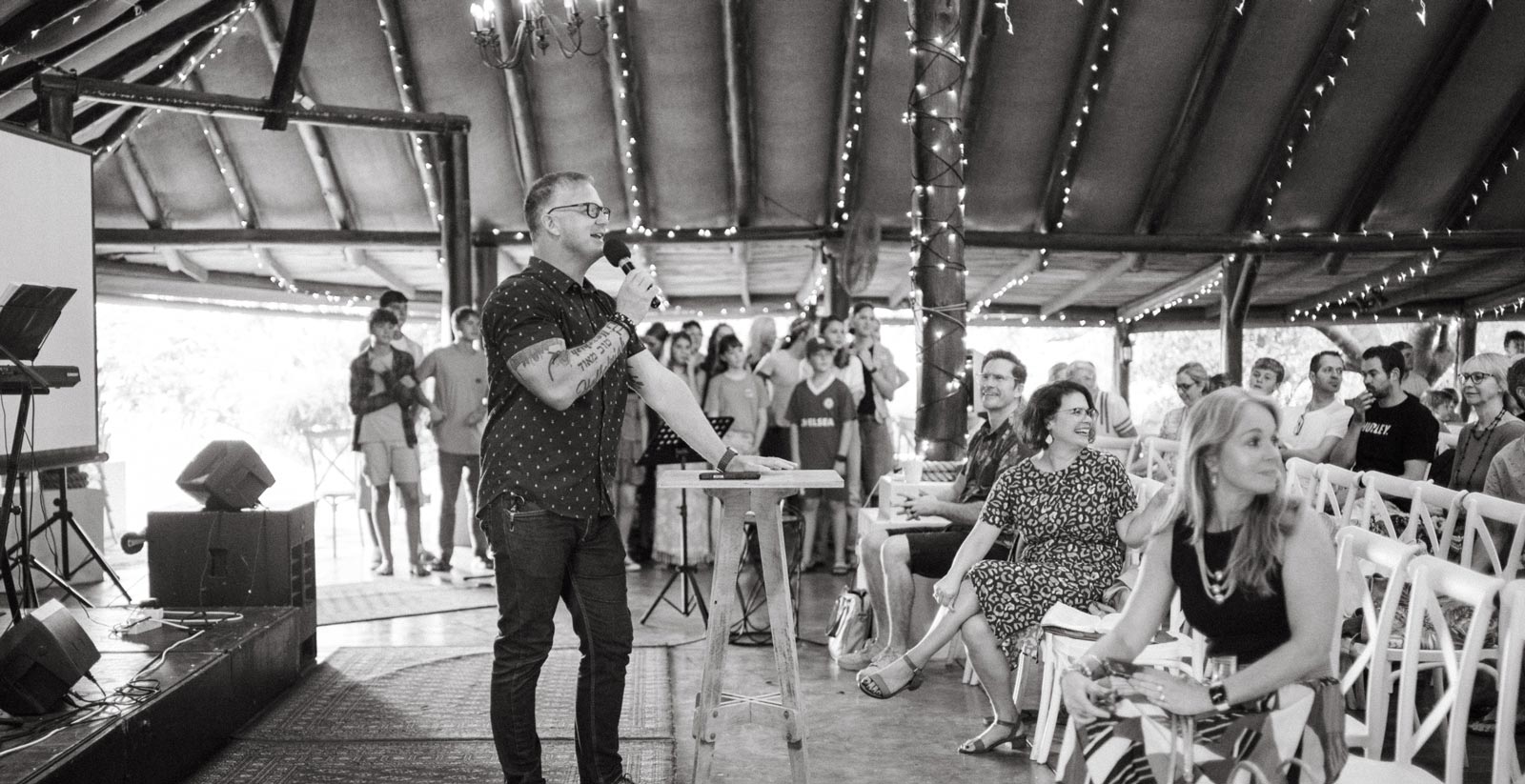
Next week we move home to the land into the tent and we will have so much space. Let us be a people who fill that space with the welcome of God.
For those who know what brokenness feels like… For those who have experienced the kindness and goodness of God through His people…
We now extend that same kindness to the broken, no matter their background, story, demographic, or category.
Because the hospitality of God has come to us, the hospitality of God now goes through us.
The summary of this message has been drafted automatically from the transcript. Its accuracy may vary.
The Table of the Undeserving: Radical Hospitality
By Nicholas Graham.
When I first walked into a church, I felt like an absolute foreigner. I had just come out of some “interesting” times, and I certainly didn’t look the part. I felt like a stranger in a strange land.
But I quickly learned something profound: I didn’t have to look like them to belong.
As we step into our new venue with its 532 chairs and wide-open spaces, God is challenging us to a radical level of hospitality.
The Stranger in Your Mind’s Eye
When I ask you to picture “the stranger,” who do you see? Often, our minds go straight to the marginalized or the poor. But I want to challenge that paradigm.
The “stranger to God” walks through our doors in many forms. It could be the drug addict or the prostitute, yes—but it could also be the billionaire or the CEO. Money doesn’t change the fact that a soul is in need of grace. Whether they have everything or nothing, if they don’t know Jesus, they are aliens to the Kingdom.
Our mission is simple: Welcome them all.
Avoiding the “Gauntlet”
There is a difference between being a “friendly church” and a “welcoming church.”
I remember the “Glenridge Gauntlet”—a doorway where 60 well-meaning people stood in two lines to greet you. As a “confident introvert,” that was my nightmare. I’d be the guy outside trying to tie my shoelaces for ten minutes just to avoid the crowd!
True hospitality isn’t a performance; it’s a natural connection.
- Don’t pander to the rich while ignoring the foreigner.
- Risk the embarrassment. If you see someone you don’t recognize, go say hello. Even if they’ve been here for two years and you just haven’t met them yet, it’s a risk worth taking.
The Divine Origin of Hospitality
Hospitality didn’t start with us; it started with God. From Genesis to Revelation, God is the Ultimate Host.
19 Consequently, you are no longer foreigners and strangers, but fellow citizens with God’s people and also members of his household
— Ephesians 2:19
- In Eden: He created a home and invited humanity to dwell with Him.
- In the Wilderness: He provided manna and water to an undeserving people.
- On the Cross: This is the ultimate act of hospitality. While we were still enemies—not just strangers, but enemies—He made a table, He made a home, and He became the meal so that we could become family.
Hospitality is God’s initiative, not our merit. Missional Hospitality: Soup and Bread
We often hold back from inviting people into our homes because we feel we don’t have an “elaborate spread” to offer.
I want to honor people in our community like Margie Reed, and Pat and Jen. They epitomize the gift of hospitality. It’s not about five-course meals; it’s about a warm bowl of soup, a cup of tea, and a listening ear.
Nothing evangelizes like a dinner table. It is evangelism without words.
When you open your home, you are creating a space for the “sticky stuff”—the glue that turns a crowd into a community.
— Nicholas Graham,
Welcome the Stranger.
A Note on Digital Hospitality
Hospitality doesn’t stop at your front door; it extends to your social media. Lately, I’ve seen Christians using their platforms to slate and “expose” others. That is the opposite of the fragrance of Christ.
Let our digital spaces be a place of welcome and grace, reflecting the home God is building for us.
From the Land to the Feast
I am excited about our new tent, but I might be even more excited about what happens after the meetings:
- The fire pits.
- The family picnics on the green lawns.
- The “feral” kids running around in freedom.
We have been given a big new home, and my prayer is that the fragrance of this house would be Love. Silver and gold we may not have, but the presence of God is a feast we can share with everyone.
A Closing Prayer
Lord, thank you that while we were still your enemies, you took the initiative. You became the meal and invited us to the table. Help us to take this journey together. Holy Spirit, stretch our tent pegs. Open our eyes to the stranger. May no one ever walk through the doors of Freedom House and not feel the undoing kindness of Your grace. Amen.